
Export / import spongram-brain/v1
A single versioned JSON file holds the entire brain. Re-imported elsewhere, every episode is re-extracted and re-dated — nothing overwritten, nothing lost.
Second memory for Claude Code & Claude Desktop
Every conversation feeds a living knowledge graph — extracted, consolidated and recalled by your own models, on your own infra. Exportable in one click. Zero lock-in, zero leak.
Export cloud → import desktop: every memory is re-extracted and re-dated in ~10 seconds. spongram-brain/v1 format, portable across instances.
Extraction, embeddings, consolidation: it all runs on your GPUs, on your own infra — never a third party.
Every entity is a node in the 3D Cortex, updated live over SSE the moment a new memory lands.
Product, explorers and admin, entirely bilingual — translation parity verified key by key.
Portability
The whole brain — episodes, entities, dated facts — exports and re-imports through the open spongram-brain/v1 format. No data is a prisoner of the instance that created it.
A single versioned JSON file holds the entire brain. Re-imported elsewhere, every episode is re-extracted and re-dated — nothing overwritten, nothing lost.
Export from the cloud admin, import into the desktop app (or the reverse): the format is identical on both sides, no migration script needed.
The Desktop edition ships a dedicated Backup card in settings — schedulable export, one-click restore, no external database required.
Entity, fact, or whole instance: you choose what stays. Zero forced retention, zero crippled export.
The command deck
Four real screens from the production cloud admin — dark-first, a living Cortex dome, full-screen explorers.
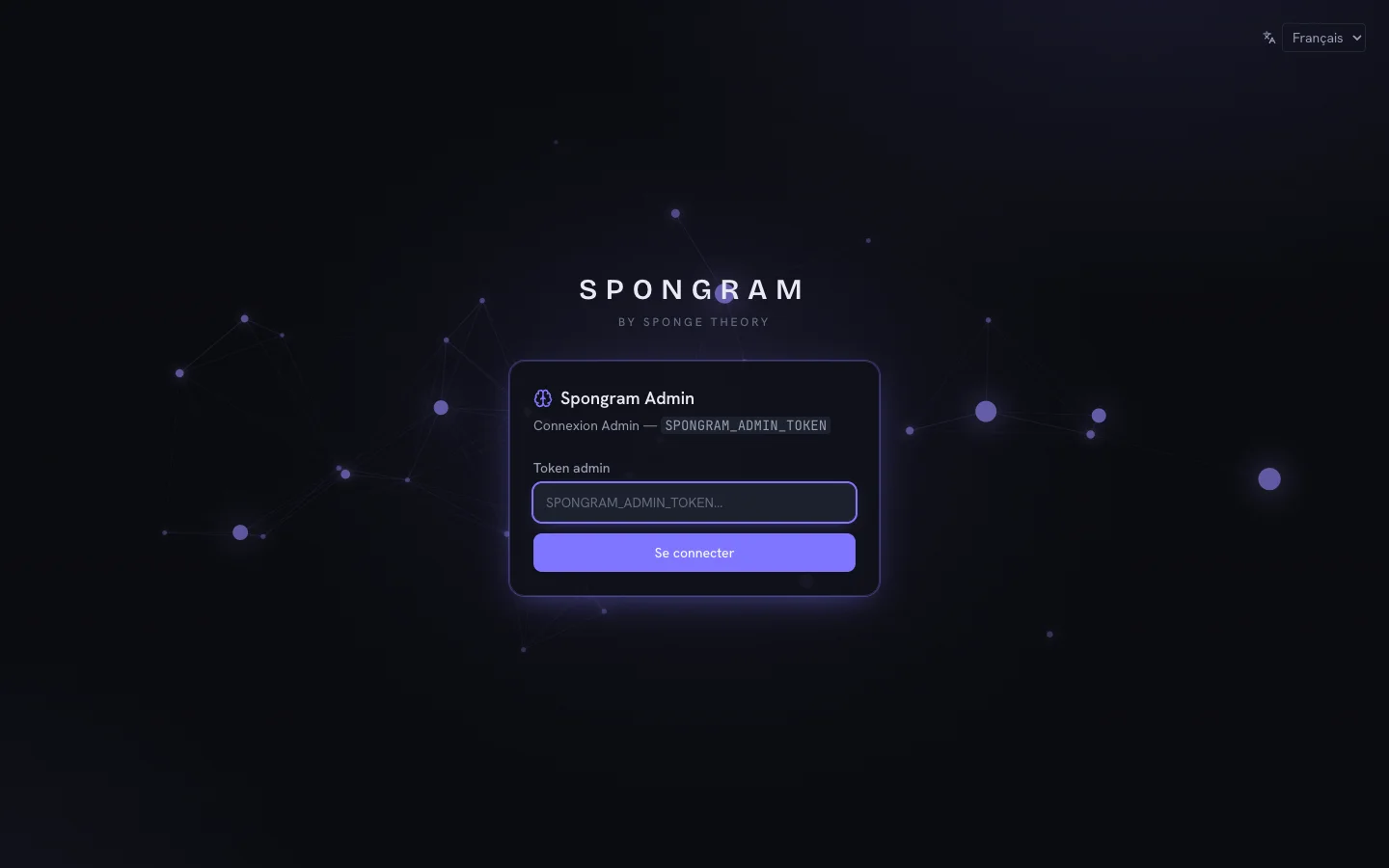

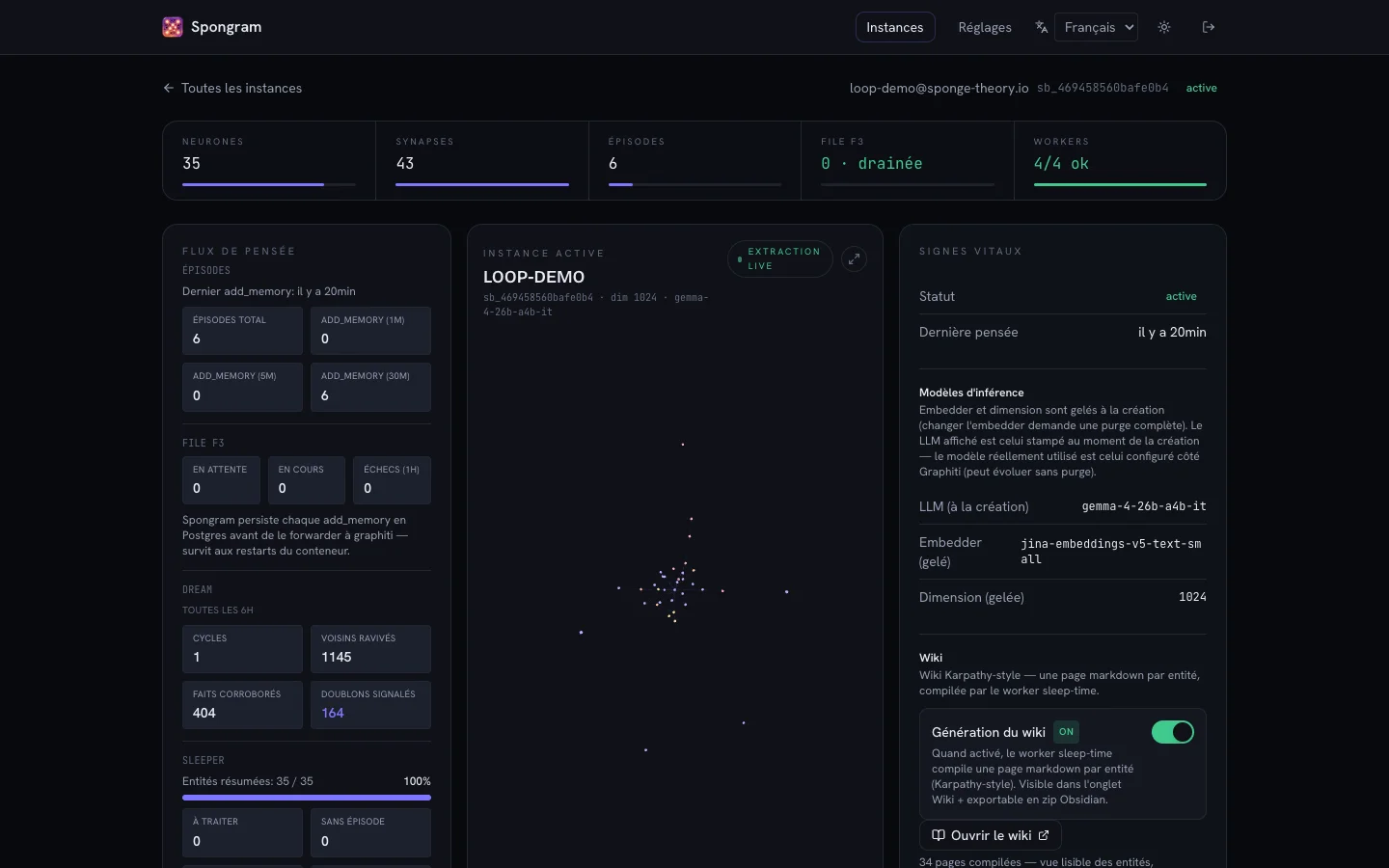
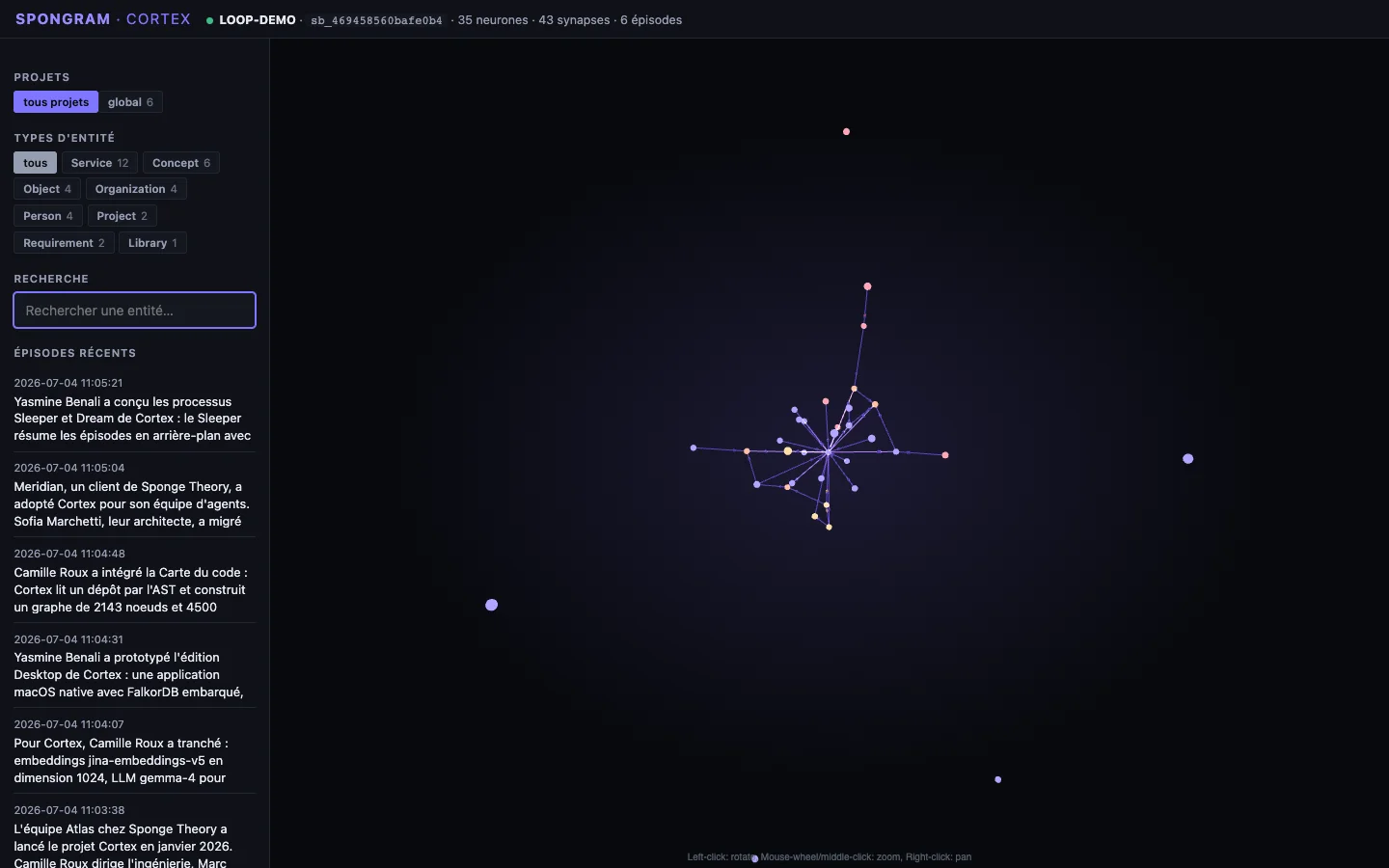
Create a brain, install the Claude Code plugin, add a first memory and recall it, open the live 3D Cortex, export cloud → import desktop cross-instance, full-screen explorers, and the desktop backup card — captured on the real product, not a mockup.
Postgres + Neo4j + Graphiti + LLM all self-hosted. No episode token ever leaves your network. Runs on Docker Swarm or plain compose.
Strict per-tenant isolation via server-injected `group_id` with anti-tampering. One instance, N brains, zero cross-leak.
Per-tenant `.plugin` bundle generated on the fly: marketplace, SKILL.md, SessionStart hook. `claude plugin install spongram` and memory is online.
Every fact carries `valid_at` / `invalid_at`. When you correct an entry, the old one is superseded — the history stays auditable.
Ollama, LM Studio, local vLLM, OpenAI, Anthropic, Mistral, Groq, or any OpenAI-compat endpoint. Hot-swap from the admin, zero restart, zero lock-in. One-click 3-layer validation (chat / tool_calls / strict json_schema).
Deterministic AST extraction (tree-sitter) of your repos → a multi-tenant structural graph queryable through 5 MCP tools. Measured in a real bench: −68% cost on architecture questions, ~2× faster than grep/read.
Every capability listed here is verifiable in the shipped codebase.
Spongram maps your repos via AST (tree-sitter) and exposes the graph to Claude Code through 5 MCP tools. Everything below is measured in real claude -p sessions, on the Spongram repo itself — protocol and runner ship with the product (docs/BENCH_CODEMAP_2026-06-10.md).
| Code-navigation question | Without Spongram (grep/read) | With Spongram (code map) | Δ cost |
|---|---|---|---|
| Most central files / symbols | $0.329 — subagent + 29 greps, estimated ranking | $0.105 — 1 god_nodes call, exact graph degree | −68% |
| Package overview | $0.291 | $0.178 | −39% |
| Who calls this function? | $0.086 | $0.106 — prod + test callers in 1 call | +23%* |
| Module contents (classes, methods) | $0.128 | $0.181 | +41%* |
| Dependency path A → B | $0.107 | $0.129 | +20%* |
| Total (6 questions) | $1.05 | $0.83 | −21% |
| Cumulative response time | 293 s | 151 s | −48% |
* For point lookups grep stays cheaper — and that is exactly what the shipped SKILL tells the agent: every tool where it belongs. A/B bench in real claude -p sessions (Sonnet), 1 question per session, read-only tools, 276-file repo; total between −12% and −21% across runs.
Client-side tree-sitter (~30 languages): 276 files → 2,143 nodes / 4,509 edges in ~14 s. No indexing cost, reproducible to the commit.
code_map_query, neighbors, god_nodes, shortest_path, stats — including AST-inferred qualified module.attr() calls that grep often misses.
~110 tokens injected at session open: repo size, directories, central files. The agent is oriented before its first tool call.
A memory that mentions a file or symbol automatically surfaces its code nodes in search_nodes. The map stays fresh via the git post-commit hook.
3D “Code map” tab; portable graph on Neo4j (cloud) / embedded FalkorDB (desktop), tenant-isolated.
Spongram speaks OpenAI-compat. Nine presets plus a Custom mode for any endpoint. Hot-swap from the admin, 3-layer validation built in.
All driven by the same admin Settings page. “Test connection” button → 3-layer probe (chat / tool_calls / strict json_schema) → you know in 3 seconds whether your provider is Graphiti-compatible.
A single FastAPI instance serves the MCP, the admin SPA, the 3D Cortex explorer and this landing. Everything else is Postgres + Neo4j, side by side.
Direct purchase via Lemon Squeezy. Same memory engine, same code map — you choose where it runs.
Self-hosted multi-tenant, for teams and GPU infra
Self-host license, source included, deployment documentation.
Native app, 100% offline, zero Docker
Lifetime per-seat license, Lemon Squeezy activation built into the app.
On purchase you receive the Docker images and the env template. Three steps, 10 minutes on any box with Docker.
cp .env.example .env
# set SPONGRAM_ADMIN_TOKEN + SPONGRAM_INFERENCE_API_KEY
# point SPONGRAM_INFERENCE_BASE_URL to your OpenAI-compat endpointdocker compose up -d
# Postgres + Neo4j + Spongram come up;
# SQL migrations applied automatically# Admin console: http://localhost:8091/admin/
# create an instance, copy the spt_brain_ key (shown once)
claude marketplace add https://your-host.tld/admin/api/spongram/marketplace.json
claude plugin install spongramFor prod: Docker Swarm behind Traefik, deploy via Portainer. Full documentation shipped with purchase.
A multi-tenant long-term memory for Claude agents. Spongram packages Graphiti, its client bundles, its admin and its inference into one coherent product that you deploy yourself.
You can. If your primary constraint is strict multi-tenant + 100% on-prem + one-click Claude Code integration with a production-ready deliverable, Spongram ticks all three in V1. If not, pick the product that covers your actual need.
None specifically — Spongram speaks OpenAI-compat. Pick your provider in the admin (9-preset dropdown: SPT Models, Ollama, LM Studio, local vLLM, OpenAI, Anthropic via adapter, Mistral, Groq, or Custom). Hot-swap, no restart. A 3-layer probe validates that your provider supports tool_calls + strict json_schema before you save.
A lot on structural questions: "what are the most central files" costs −68% (one code_map_god_nodes call replaces a subagent + 29 greps, and is the only exact answer), a package overview −39%. Across a 6-question real bench: ≈ −17% total cost and ~2× faster. For a bare "where is X defined", grep stays cheaper — and that is what the SKILL tells the agent. Numbers and protocol ship with the product, reproducible.
Two editions, direct purchase via Lemon Squeezy: Spongram Desktop (lifetime per-seat license — macOS available, Windows/Linux in preparation) and Spongram Cloud (self-host license, source included). For assisted, multi-site or volume deployments: contact@sponge-theory.ai.